

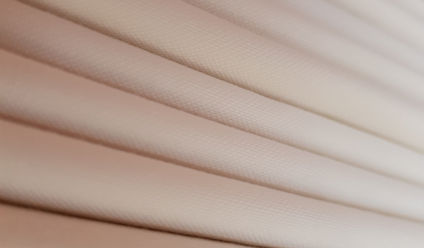
DOE Energy Test Cloth
Batches: QC Batch/Lot Data, Correction Coefficients
MSDS: not available
DOE Clothes Washer Rulemaking: Appendix J1
Standardized test cloth (Energy Test Cloth) is used to simulate a washer load of clothes in a test determining the RMC.
The U.S. government established the first federal test procedures for clothes washers in 1977. In the 1990’s, concurrent with the development of new energy conservation standards for clothes washers, the Department of Energy began revising the clothes washer test procedure.
The current appendix J1 test procedure specifies an energy efficiency descriptor called the modified energy factor (MEF). In contrast with the previous EF descriptor which only calculated the energy use of the clothes washer itself, the MEF descriptor accounts for the remaining moisture content (RMC) of clothes leaving the clothes washer. In order to calculate the RMC, appendix J1 requires manufacturers to use a particular lot of standardized test cloth (Energy Test Cloth) to simulate a washer load of clothes.
The DOE Energy Test Cloth is available from wfk:
-

DOE Energy Test Cloth
DOE Energy Test Cloth, large, polyester/cotton, approx. 22” x 34” (approx. 56 cm x 86 cm)
SKU: 99117 Width/Size 56 cm x 86 cm
-
DOE Energy Test Cloth
DOE Energy Test Cloth, small, polyester/cotton, approx. 10” x 10” (approx. 25 cm x 25 cm)
SKU: 99118 Width/Size 25 cm x 25 cm
Fabric Specifications
| Parameter | Specification |
|---|---|
| Yarn composition | Cotton/Polyester 50/50 CO in warp and weft each 50% ± 4% |
| Area weight | (190 ± 8,4) g/m² |
| Weave | Momie or Granite weave |
| Thread count Warp Weft | 65 / inch ± 2% (≈ 25 / cm ± 2%) 57 / inch ± 2% (≈ 22,4 / cm ± 2) |
| Yarn count Warp Weft | 15/1 cotton count ± 5% (≈ Nm 25 / 39 tex ± 5%) 15/1 cotton count ± 5% (≈ Nm 25 / 39 tex ± 5%) |
| Lin. density of yarn in finished fabric Warp Weft | (wfk internal specification, not formally required) 35,5 tex ± 5% 35,5 tex ± 5% |
| Yarn twist Warp Weft | (wfk internal specification, not formally required) 410 - 450 t/m 410 - 450 t/m |
| Yarn construction | Open end spun |
| Finish | Pure finish: desized/washed, bleached, without optical brightener |
| Colour | White |
Quality Control
Samples of the lots are tested by a formally approved test lab; the results are then evaluated and the lot officially approved by the AHAM DOE Task Force to confirm the required quality and establish the correction coefficients.
Correction coefficients
The Correction Coefficients for different lots can be found here.